
QR-CODE garden



photos : Wagon et Studio Basta
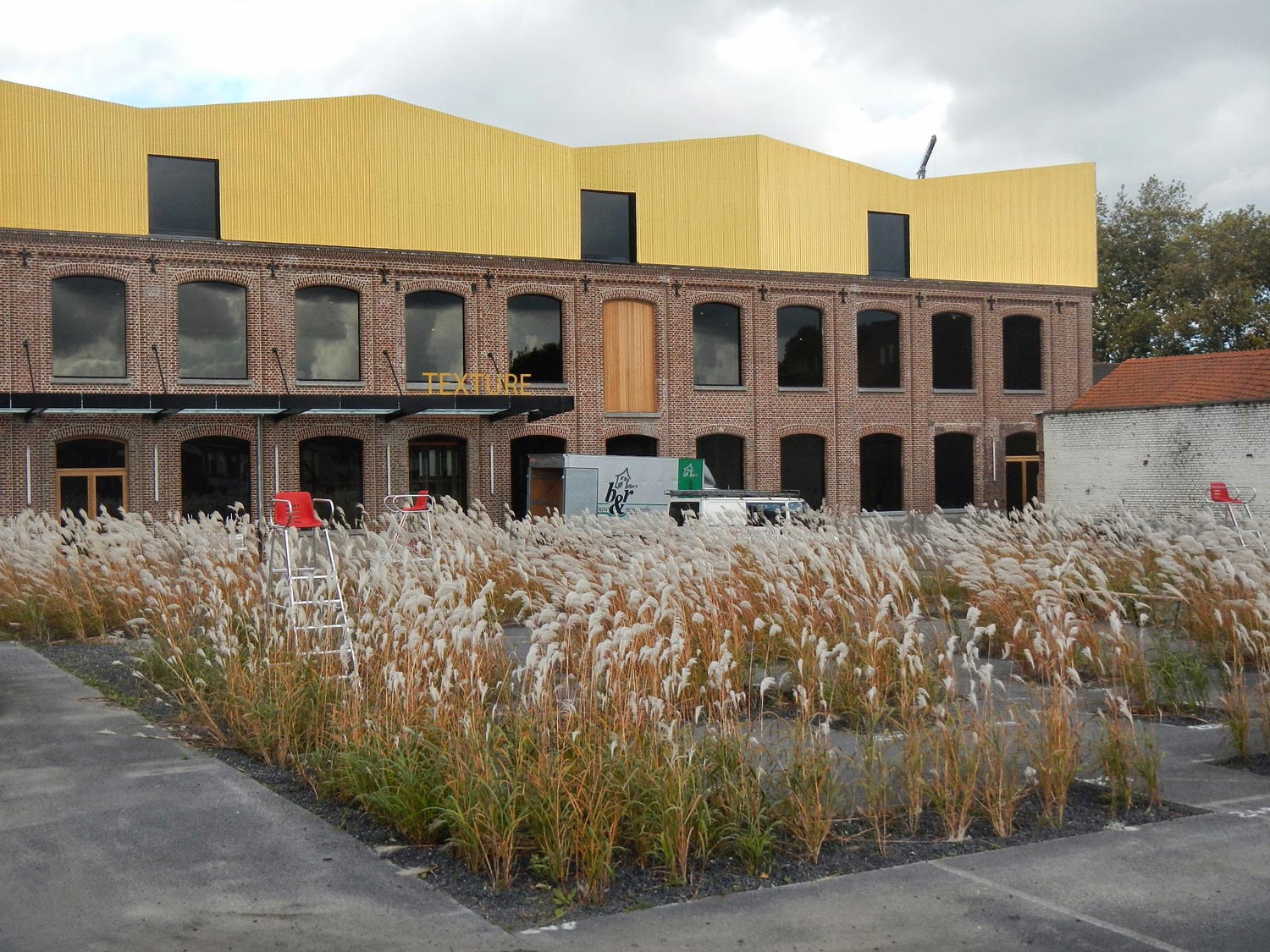
The new Flax Museum is located along the banks of the Leie in Kortrijk, celebrating a past in which flax cultivation represented a major resource for the region. Faced with a very limited budget for the redesign of the surrounding public spaces, the project proposes a frugal intervention based on the reuse of the existing car park, considered as a resource rather than a constraint. The garden thus becomes a demonstration of the capacity of urban public spaces to reinvent their uses without heavy reconstruction.
The forecourt garden is structured around a simple and immediately legible design: the museum’s QR code becomes the generative plan of the project. The solid areas of the pattern are planted with Miscanthus giganteus, forming a dense, highly graphic vegetal mass. The voids create open clearings within the tall grasses, punctuated by a few tennis umpire chairs. The contrast between the powerful planting and the raw materials already in place — asphalt and gravel — allows for a radical transformation of the space while preserving the memory of the ground.
The project relies on maximum site recycling. Levels, networks and drainage are maintained. The asphalt is simply cut and planting pits are created. This approach ensures a highly accessible surface, limits costs, avoids the creation of new networks and lighting, and enables rapid implementation, completed in five months with the involvement of local residents.
The use of a single plant species simplifies maintenance, limited to one annual cut at the end of winter. Over the seasons, the garden undergoes strong transformations, echoing the cycles of field crops: young shoots in spring, tall stems in summer and autumn, and bare ground at the end of winter. The perception of the space shifts continuously, from an open forecourt to a landscape of meandering planted masses, and finally to a labyrinthine form.
Year : 2014